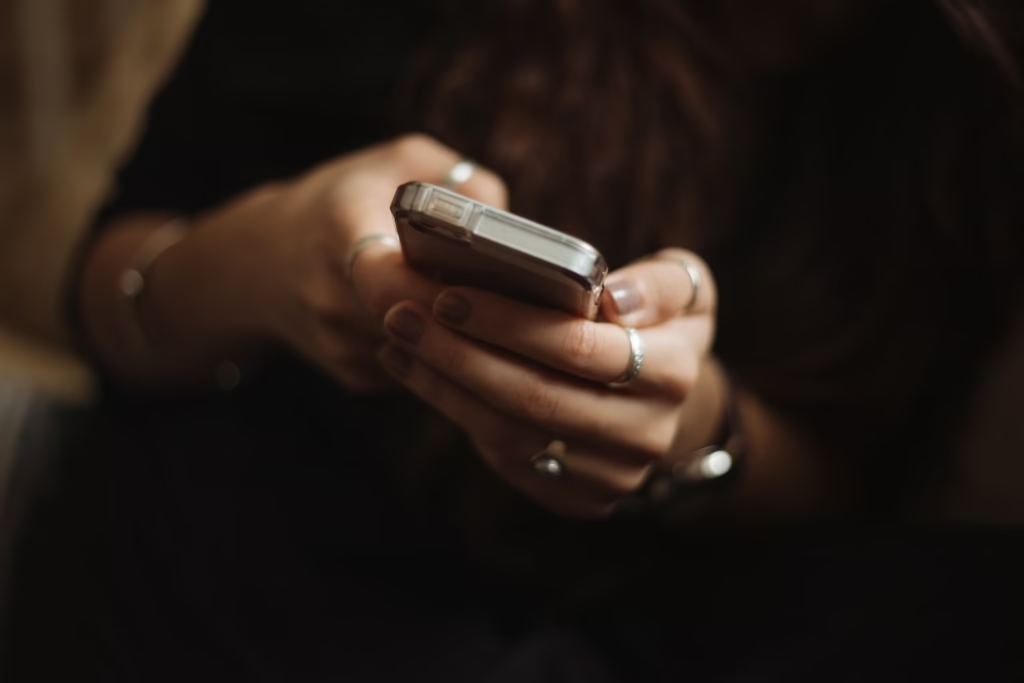
You think you make choices, but algorithms draft the menu. Here is how tech companies affect daily life—from the “dopamine loop” to the invisible infrastructure of your wallet.
How Tech Companies Affect Daily Life: The Invisible “Convenience Tax”
You wake up. You don’t look at the window; you look at a screen. You don’t hail a cab; you summon an algorithm. You don’t walk through a video store; you let a database tell you what you “might like.”
We think we use technology as a tool, like a hammer. But a hammer doesn’t nudge you to hit more nails at 2 AM.
At BinarySpur, we analyze the code behind the culture. The reality is that Big Tech doesn’t force you to do anything—they just make the path they want you to take the path of least resistance.
How Tech Companies Affect Daily Life (In Simple Terms)
Tech companies affect daily life by shaping how we spend attention, money, and time. Through algorithms, frictionless payments, and behavioral design, they influence what we buy, what we see, and how often we check our phones—often without us realizing it. They replace conscious choices with automated “suggestions.”
TL;DR – The 3 Layers of Influence
1. The Dopamine Layer: Apps are engineered like slot machines (Variable Rewards) to keep you scrolling.
2. The Frictionless Layer: Amazon and Uber remove the “pain” of paying, causing you to spend more.
3. The Algorithmic Layer: You aren’t seeing “the news.” You are seeing a curated reality designed to keep you engaged (usually through emotion).
1. The Morning Loop (Dopamine Engineering)
Before your feet hit the floor, you have likely interacted with three tech giants.
The alarm (Apple/Google). The social check (Meta). The news (X/Twitter).
The Mechanism: This is called “The Attention Economy.”
Tech companies do not sell products; they sell your attention to advertisers.
-
The Effect: Your brain starts the day in a reactive state (consuming) rather than a proactive state (creating). This kills deep focus for the next 4 hours.
(Psychologists call this the “Variable Reward” schedule—the same mechanism used in gambling).
2. The “Convenience Tax” on Your Wallet
Why is it easier to order a $20 pizza on an app than to cook the $5 pasta in your pantry?
Friction.
Tech companies excel at removing friction.
-
Uber/DoorDash: You don’t see cash leaving your hand. It’s invisible.
-
Amazon 1-Click: You don’t have to type your address.
-
The Result: When payment is painless, spending increases. Behavioral economics research (HBR) suggests that frictionless digital payments can increase spending by 20-30% compared to cash. We call this the “Convenience Tax.”
3. The Death of Boredom (And Creativity)
When was the last time you stood in line and just… stared at the wall?
Probably 2007.
Now, the moment a second of boredom appears, the phone comes out.
The Problem: Boredom is the biological trigger for creativity and problem-solving. By filling every micro-moment with content, tech companies have effectively outsourced our imagination.
The Choice Matrix: You vs. The Algorithm
Are you choosing, or are you settling?
| Activity | Pre-Tech Reality | Tech Reality (The Algorithm) |
| Watching a Movie | You walk aisles, read boxes, risk a bad choice. | Netflix shows you 5 matches based on past data. |
| Navigation | You learn the map and landmarks. | You follow a blue line blindly (Turn-by-turn). |
| Shopping | You buy what you need. | You buy what the “Targeted Ad” suggests. |
| Dating | You meet in context (work, friends). | You swipe on static images (Gamification). |
4. The “Always On” Workplace
Tech promised to save us time. Instead, it erased the boundary between “Work” and “Home.”
Slack and Email mean you are reachable at dinner.
The Reality: We are not more productive; we are just more responsive.
(If your laptop is slowing down your workflow, read our guide on [[What to Check Before Buying a Laptop]] to upgrade your infrastructure).
5. Who Wins From the Convenience Tax?
It is important to follow the money. When tech companies remove friction, who actually benefits?
-
The Platforms (Winner): They get your data and your retention. The longer you stay, the more they win.
-
The Advertisers (Winner): They get precision targeting to sell you things you didn’t know you wanted.
-
The Consumer (Loser): You get short-term comfort (delivery, endless scrolls) but pay the long-term cost in focus, wallet health, and mental clarity.
6. Real-Life Micro-Story: The “Smart” Home Trap
“I bought smart bulbs, a smart lock, and a smart speaker. I felt like I was living in the future.
Then my internet went down. I couldn’t turn off my lights. I couldn’t check my doorbell.
Lesson: I traded a physical switch (which works 100% of the time) for a digital dependency. Tech adds capabilities, but it also adds points of failure.”
Final Thoughts: Be the Admin, Not the User
We aren’t Luddites. We love tech. But we respect it as a powerful tool, not a lifestyle.
To reclaim your life, you must introduce intentional friction:
-
Turn off notifications (except calls).
-
Buy a physical alarm clock.
-
Pay with cash once a week to feel the money leaving your hand.
Tech companies affect daily life by designing the path of least resistance. Your job is to occasionally choose the difficult path.
(To ensure your digital environment is clean and under your control, check our guide on a [[Clean Install of Windows]]).
Frequently Asked Questions
Does technology increase anxiety?
Yes. Studies show a direct correlation between high social media usage and anxiety. This is driven by “FOMO” (Fear Of Missing Out) and the constant comparison of your “behind-the-scenes” life to everyone else’s “highlight reel.”
How do algorithms know what I want?
Data Aggregation. Companies track your search history, location data, dwell time (how long you look at a post), and purchase history. They build a “Digital Twin” profile of you to predict behavior better than you can.
How do tech companies affect daily life regarding sleep?
Blue light and dopamine. Tech companies design apps to be “bottomless” (infinite scroll), which delays sleep. Additionally, the blue light from screens suppresses melatonin, physically tricking your brain into thinking it is still daytime.