The Truth About Mid-Range Android Phone Performance: Do You Really Need a Flagship?
It is the classic sales pitch. You walk into a carrier store, and the rep immediately steers you toward the $1,200 Ultra/Pro/Max model. They talk about “blazing fast chips” and “titanium frames.”
You look at the $400 mid-range phone next to it and wonder: Will this thing be slow? Will it lag in six months?
Five years ago, the answer was yes. Cheap phones were bad. But in 2026, the game has changed.
When we analyze mid-range Android phone performance, we are witnessing a phenomenon called “Hardware Saturation.” The chips in budget phones today are close to or matching the real-world performance of flagships from just a few years ago.
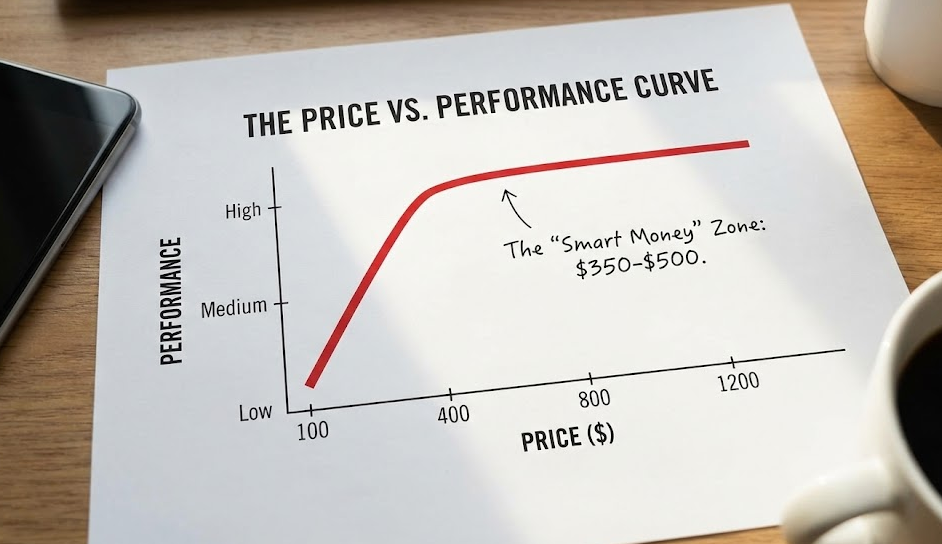
According to recent benchmark comparisons and long-term usage tests, performance gains above the $500 price point show diminishing real-world returns.
The hard truth: Most users are paying an $800 “Flagship Tax” for power they never actually use.
 Quick Answer: Where the Speed Gap Actually Is
This is the reality of mid-range Android phone performance for the average user.
Flagship vs. Mid-Range Cheat Sheet (TL;DR)
App Opening Speed:
No difference (Milliseconds).
Social Media Scrolling:
Heavy Gaming (Genshin Impact):
Flagship wins (Mid-range stutters at Max settings).
Video Editing/Rendering:
Battery Life:
Mid-range often wins (Lower power chips = longer life).
The Golden Rule: If you don’t edit 4K video or play competitive 3D games, a flagship processor is like buying a Ferrari to drive in a school zone. You can’t use the speed.
1. The “Daily Driver” Illusion
We tested a Pixel “A” series (Mid-range) against a Galaxy “Ultra” (Flagship). We opened Instagram, TikTok, Maps, and Gmail. The result? You couldn’t tell them apart.
Modern mid-range chips (like the Snapdragon 7 series or MediaTek Dimensity) are optimized for efficiency, not raw benchmark numbers. For example, the Snapdragon 7 Gen 3 found in many $400 phones benchmarks surprisingly close to older flagship chips like the Snapdragon 8 Gen 1 in everyday tasks. Unless you are rendering a 10-minute 4K vlog on your phone, you simply won’t feel a slowdown.
Elite Insight: Benchmarks like Geekbench exaggerate differences. A 20% higher score rarely translates to 20% faster Instagram.
2. The Camera Trap (Daylight vs. Night)
This is the only place where the extra money truly counts. In broad daylight, a $400 phone takes photos that look very similar to those from a $1,200 phone for most people. They both have great sensors and decent HDR.
The separation happens in two places:
-
Low Light: Flagships have larger sensors that “see” in the dark. Mid-rangers get grainy.
-
Zoom: Flagships have telephoto lenses. Mid-rangers usually just “digital crop” (which looks blurry).
The Verdict: If you are a casual photographer, mid-range is fine. If you are a content creator filming in dark clubs or concerts, buy the flagship.
 Do NOT Buy These “Mid-Range” Traps
Do NOT buy phones with less than 6GB of RAM. (Android needs 6GB minimum to run smoothly today. 4GB is e-waste). Do NOT buy “Carrier Special” versions. (They are often loaded with bloatware that slows down the processor). Do NOT ignore the update promise. (Only buy mid-rangers that promise at least 3 years of security updates).
Why: A fast chip means nothing if the software is bloated or obsolete.